Optima (Priority) vs. EZGO: Modular vs. Unified Stack
The last decade has rewritten how hotels operate. More channels, more data, and far more moving parts. Guests expect seamless experiences across every touchpoint, and hoteliers…
Eliav Rotholz
vGuest
A Practical Guide to Choosing a PMS for Modern Hospitality
The last decade has rewritten how hotels operate. More channels, more data, and far more moving parts. Guests expect seamless experiences across every touchpoint, and hoteliers are expected to manage it all — often with smaller teams and tighter margins.
That’s why the choice of PMS is no longer just a technical decision. It’s a strategic one.
When comparing systems today, the real question isn’t who has more features, but which system philosophy aligns with how your business runs — and how it plans to grow.
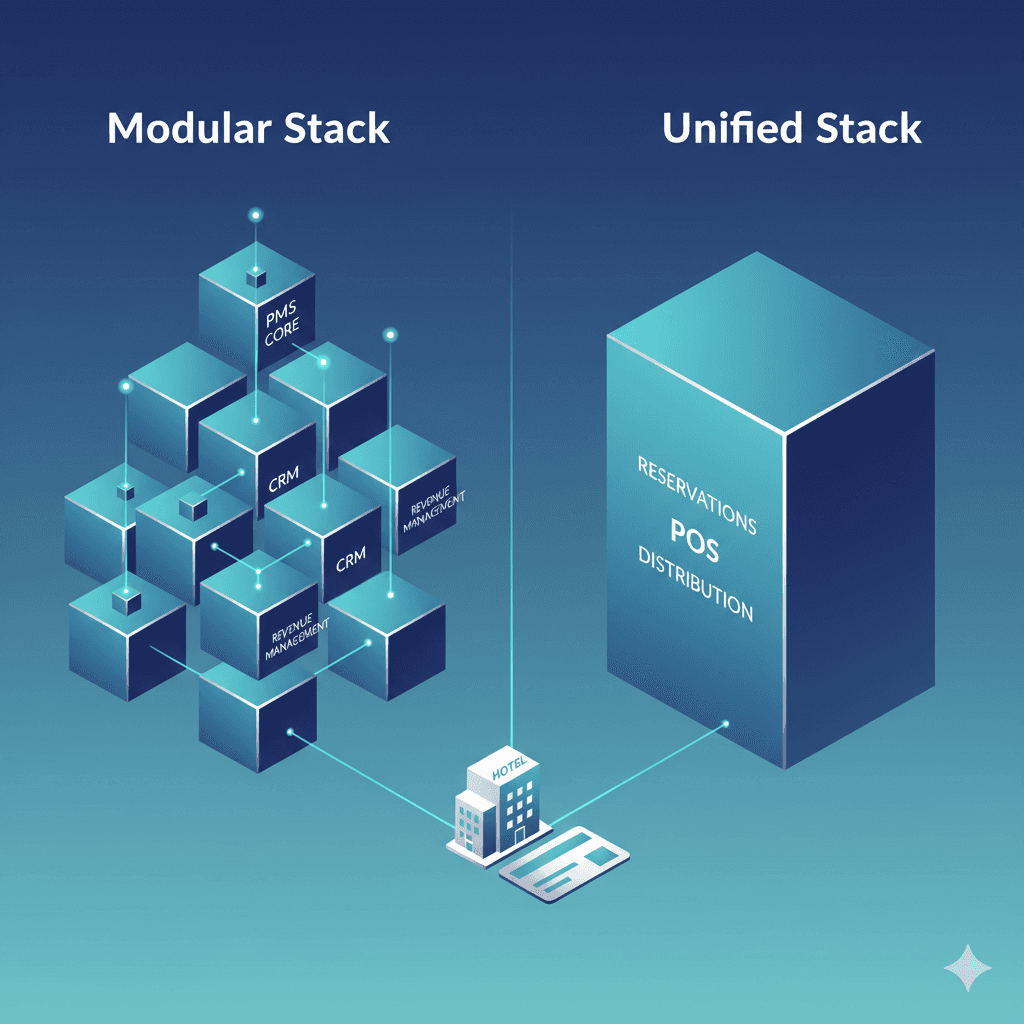
Two dominant approaches shape most hotel tech stacks today:
- A modular stack built around a stable PMS core that connects to specialized tools.
- A unified stack that centralizes nearly everything in one cohesive platform.
This article breaks down these philosophies through the lens of two leading systems — Optima (Priority) and EZGO — and offers a practical rollout plan and RFP checklist to help you make the right choice.
Stack Philosophies in Brief
Optima (Priority): The Modular Core
Optima (Priority) is built on a proven PMS foundation. It acts as the hotel’s central system of record, handling reservations, guest profiles, folios, and housekeeping — while allowing third-party tools to plug in for functions like guest messaging, reviews, or business intelligence.
The strength of this model is flexibility. You can upgrade or replace tools without disrupting the core system. For multi-property operators or groups that manage their own IT, this flexibility becomes a long-term advantage.
EZGO: The Unified Stack
EZGO follows a different philosophy — a single, unified platform that includes PMS, booking engine, channel management, POS, spa and events management, and more.
The benefit is simplicity. One login, one data source, and one vendor responsible for the entire workflow. Deployment is fast, and staff onboarding is easy because everything looks and feels consistent.
The question isn’t which one has more features. It’s which architecture fits your operational reality — your IT capacity, your business scale, and your tolerance for vendor dependency.
Core Scope- What Comes Out of the Box
Optima (Priority) offers a robust PMS core — covering reservations, folios, guest profiles, housekeeping, maintenance, and detailed reporting. It supports multi-property operations with strong permission management and audit trails. The intent is clear: keep the foundation reliable and let specialized systems evolve around it.
EZGO, meanwhile, includes many of these capabilities out of the box — from spa and events to POS and distribution. It’s built for teams that want an immediate, all-in-one solution with minimal setup.
Reservations and Distribution- Choice vs. Control
Optima (Priority) integrates with multiple booking engines and channel managers via open APIs. Hotels can fine-tune how inventory and pricing appear across channels, allowing for creative control over direct booking experiences and localized campaigns.
EZGO consolidates these functions into a single environment. Its built-in booking engine and channel management tools create one synchronized source of truth for rates and availability. It’s fast, accurate, and reliable — though less customizable if you prefer to work with external partners or niche OTAs.
Ecosystem and Integrations- Openness vs. Cohesion
Optima is built for openness. It lets hotels connect best-in-class tools — from AI-driven guest communication to loyalty systems or advanced revenue platforms. That flexibility does require a capable IT or vendor-management function to maintain integrations, test updates, and handle data consistency.
EZGO, by contrast, prioritizes cohesion. Every module is native and deeply integrated, meaning fewer vendors to manage and fewer technical surprises. The trade-off is dependency: once you’re in, switching providers can be challenging.
Deployment, Security, and Multi-Property Management
Optima (Priority) supports both cloud and hybrid deployments. Its permission system and data governance features make it suitable for chains with strict IT policies or compliance frameworks. It’s ideal for groups that require autonomy at the property level but centralized oversight at the corporate level.
EZGO is fully cloud-native. It’s designed for multi-property management out of the box, with unified dashboards, centralized workflows, and consistent data models. That simplicity comes with strong security standards and automatic updates — a major benefit for operators without internal IT teams.
Reporting and Data Accuracy
Optima provides flexible reporting tools and allows exports to external BI systems like Power BI or Tableau. For data-driven teams, this openness supports deeper performance analysis and long-term planning.
EZGO offers built-in dashboards and operational reports that cover daily hotel metrics — occupancy, ADR, RevPAR, and department-level revenue. For most operators, these insights are sufficient without needing third-party analytics.
Which Fits Your Organization Best?
Optima (Priority) is best suited for: - Hotels or groups that want modularity and control.
- Organizations with IT or data teams to handle integrations.
- Businesses planning for scalable, long-term infrastructure rather than one-size-fits-all simplicity.
EZGO fits operators that: - Prefer speed and simplicity.
- Have limited IT resources and need minimal vendor management.
- Operate mainly in regional markets but value centralized control and fast rollouts.
In short: Optima is a platform to build on; EZGO is a platform to run on.
The External Service Layer- Flexibility Above the PMS
Many hotels now add an external guest-service layer above their PMS. This layer — often a guest-messaging or task-automation system — connects to essential PMS data like stay details, identity, and charges.
The benefit? It keeps your guest operations flexible, even if you later switch booking engines or channel managers. It’s not a product — it’s an architecture decision that future-proofs your stack and prevents vendor lock-in.
A Short Rollout Plan
- Assessment → Preparation → Pilot → Scale → Operation
A structured rollout minimizes downtime, reduces training friction, and builds internal trust in the new system.
RFP / POC Checklist
Modules: Reservations, folios, housekeeping, POS, events/spa, multi-property.
Integrations: OTA connectivity, payments, CRM, accounting, BI.
API & Documentation: Scope, rate limits, permissions, sandbox access.
Data & Compliance: Fields, retention, deletion, backups, logs.
Security & Payments: ISO/PCI standards, encryption, audits, patch cycles.
Implementation & Support: SLA, go-live plans, training, ongoing support.
TCO (Total Cost of Ownership): Licensing, integration, maintenance, and long-term operational costs.
The Bottom Line
There’s no one-size-fits-all PMS.
Optima (Priority) excels in modularity and long-term adaptability.
EZGO thrives on simplicity and unified experience.
The best system is the one that aligns with your strategy, team capacity, and growth stage — not just your current feature wishlist.
Technology should make your team more human, not less. The goal isn’t to replace people with software, but to give them tools that let hospitality shine again.
Common questions
What is the difference between a modular and a unified hotel tech stack?
A modular stack is built around a stable PMS core that connects to specialised tools for messaging, reviews or BI. A unified stack centralises nearly everything in one platform - PMS, booking engine, channel management, POS, spa and events. Modular gives flexibility to upgrade or replace one tool without disturbing the core; unified gives one login, one data source and one vendor accountable for the whole workflow.
How does Optima (Priority) differ from EZGO?
They follow different philosophies rather than competing on feature count. Optima is a modular core: a proven PMS handling reservations, folios, guest profiles and housekeeping, with third-party tools plugging in around it, and strong multi-property permissions and audit. EZGO is the unified approach - one platform covering PMS through POS and spa, with fast deployment and easy staff onboarding because everything looks consistent.
Which architecture should we choose?
The question is not which has more features but which fits your operational reality - your IT capacity, your scale and your tolerance for vendor dependency. Modular suits multi-property operators and groups that manage their own IT, where the flexibility to swap a component becomes a long-term advantage. Unified suits teams who need speed and simplicity over choice.
What is a modular hospitality technology platform?
A stack built around a stable PMS core, such as Optima (Priority), that acts as the system of record for reservations, guest profiles, folios and housekeeping, while specialised tools for guest messaging, reviews or business intelligence plug in through open APIs. Its strength is flexibility; the cost is that someone has to maintain the integrations, test updates and keep data consistent.
What are the pros and cons of a unified hotel tech stack?
A unified platform such as EZGO bundles the PMS, booking engine, channel management, POS, spa and events in one system: one login, one data source and one vendor, with fast deployment and easy staff onboarding. The trade-off is dependency, since switching providers can be hard, and less room to customise if you want external partners or niche OTAs.
What should a hotel PMS RFP checklist include?
Modules such as reservations, folios, housekeeping, POS, events and multi-property; integrations for OTAs, payments, CRM, accounting and BI; API scope, rate limits and sandbox access; data retention, deletion and backups; security and payment standards such as ISO and PCI; implementation and support terms; and the total cost of ownership, including integration and maintenance.
What is a guest-service layer above the PMS?
A guest messaging or task automation system that sits above the PMS and connects to essential data such as stay details, identity and charges. It keeps guest operations flexible even if the hotel later switches booking engine or channel manager, which makes it an architecture decision that reduces vendor lock-in rather than a product choice.
Keep reading
All articles
Guest Experience
Sentiment Analysis and Guest Reviews: Turning Feedback into an Upsell Opportunity
1 year ago · 4 min read
The four calls your front desk takes all day, and how to move them to WhatsApp
Yesterday · 5 min read
Official WhatsApp or the app on the front-desk phone?
Yesterday · 5 min read
190+ properties · 6 countries
See it answering your guests
Bring your own property. We will show you what the assistant does with your real questions, in your languages, on WhatsApp.