How to Simplify Guest Communication Across Booking Channels: Two Kinds of AI Platform
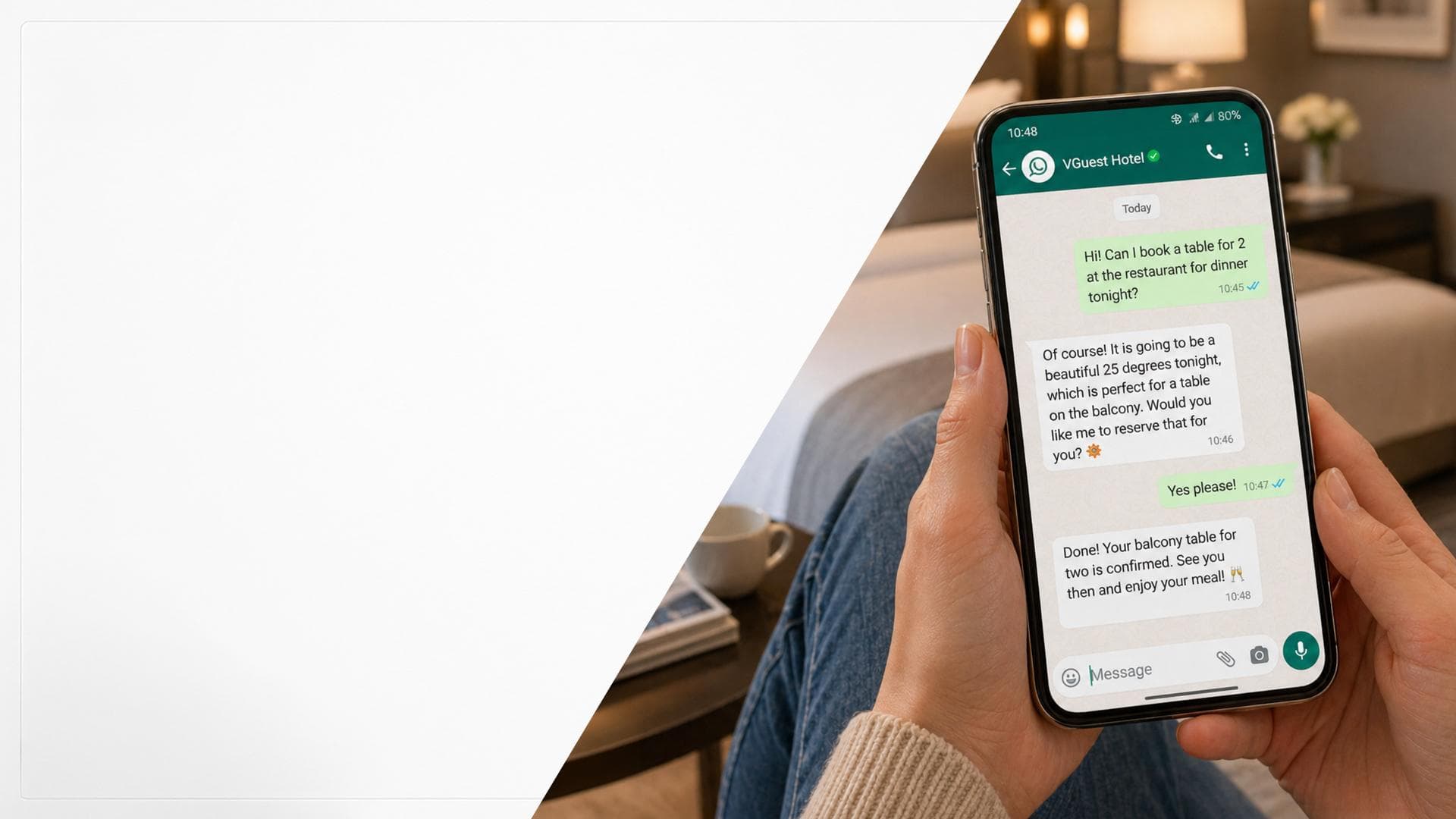
Bringing guest communication from every booking channel into one inbox is the easy part. Which of two kinds of platform you buy decides the rest.

Bringing guest communication from every booking channel into one inbox is the easy part. Which of two kinds of platform you buy decides the rest.
The short answer first. If the problem is that your website does not convert and the OTAs own your bookings, you want a pre-booking conversion tool. If the problem is that the same questions arrive on every channel after the booking exists, that requests fall between shifts and that nobody can see what was promised, you want a full-journey operations platform. The two look identical in a demo, and most bad purchases in this category come from buying one when the other was needed.
This comparison is written by a vendor in the category. That is worth stating up front, and it is why the first thing it does is name where the competition is genuinely stronger.
One inbox is the easy part
Every product here will consolidate the channels: WhatsApp, Instagram, web chat, email, and the messages sitting inside each OTA extranet. That alone stops a guest who writes in three places getting three different answers, and it is worth having. It does not reduce the amount of work. It moves the work into one window.
What reduces it is what happens after a message lands. Whether the assistant can answer from the property's own information rather than improvising. Whether it can write the outcome back into the PMS, so the front desk sees the late check-out it agreed to. And where a request goes when the assistant cannot handle it. Those three are where the two categories diverge, and the depth of each follows the spine the product was built around.
The two categories
Pre-booking conversion. The assistant sits on your website and messaging channels, quotes availability from your booking engine, compares room types, and closes the reservation inside the chat. The commercial spine is direct bookings. Asksuite is the reference product here, with an unusually deep booking-engine integration. If your problem is OTA dependence and your website converts poorly, this is the category.
Full-journey operations. The assistant handles everything after the booking exists - pre-arrival questions, digital check-in, in-stay requests, complaints, escalation to the right member of staff, and writing outcomes back into the PMS. The commercial spine is operational load and guest experience. vGuest sits here, alongside a smaller set of platforms that treat the PMS as the system of record rather than the booking engine.
The categories overlap at the edges. Full-journey platforms answer pre-booking questions; conversion platforms handle some in-stay requests. But each is built around one of those spines, and the depth follows the spine.
Where Asksuite is stronger
Honestly: quoting and closing. If a guest arrives on your site at 11pm wanting a room for Saturday, wants to compare two suites, and wants to pay - Asksuite's flow is the most refined in the category. The omnichannel inbox across WhatsApp, Instagram, Facebook and web chat is mature. Their strongest markets are Latin America and Southern Europe, where their case studies concentrate.
The case study format they use - a property name, a headline number - is also simply better content than most of the industry produces, and worth copying.
Where the full-journey category is stronger
Everything that happens once the guest has a reservation.
PMS write-back rather than read-only. A conversion tool reads availability. An operations platform writes the late check-out, the room preference, the signed check-in document back into the guest record. That difference decides whether the front desk sees what the assistant did.
Escalation as a first-class feature. What the assistant does when it cannot answer is the product for an operations team. Ticket creation, routing by topic to a role, notification on the channel staff actually watch - usually WhatsApp - and a fallback if nobody picks it up.
The knowledge base as the source of truth. The assistant answers from what the property provided and escalates otherwise, rather than improvising from a general model.
Multilingual including voice. A guest sends a voice note in a language no staff member speaks and receives a reply in that language, in the property's tone.
The four tests that separate products
Feature grids in this category are nearly identical and nearly useless. Run these with your own data instead:
- Ask it something it cannot know. Watch whether it guesses or hands over. A confident wrong answer is the most expensive thing an assistant can produce.
- Change something in the PMS and ask about it. Does the assistant reflect it? Then have the assistant change something and check whether the PMS reflects that.
- Send a frustrated message at 2am. Where does the notification land, who sees it, and how long until a person responds. That path is the actual product.
- Send a voice note in a language nobody on your team speaks. Read the reply. Then put it in front of someone who does speak it.
Any vendor confident in their product will let you run all four before a contract.
Price follows the same logic. It is driven by conversation volume, the number of properties and channels, and the depth of PMS integration rather than by features, so be wary of a quote that does not ask about your volume. Hotel chatbot pricing breaks the bill down, and hotel chatbot or AI guest assistant explains why the old scripted bots are a different product from either category here.
The honest limits of both
Neither category removes the need for a human. Complaints, accessibility requests, anything with legal or financial weight - those need a person, and the good platforms in both categories are the ones that route them fast rather than the ones that try to handle them.
And neither category fixes a property whose own information is out of date. An assistant is an unusually honest audit of what a hotel actually knows about itself.
Which to choose
If your problem is that the website does not convert and OTAs own your bookings, buy a conversion tool, and Asksuite is the one to evaluate first.
If your problem is that the front desk answers the same handful of questions all day, that requests fall between shifts, that guests are waiting for replies in languages nobody on the desk speaks - buy an operations platform, and test it on the four questions above.
If you have both problems, start with the one costing you more this quarter. The two categories integrate; you do not have to choose forever.
Common questions
How can I simplify guest communication across different booking channels?
Start by consolidating them - WhatsApp, Instagram, web chat, email and the messages sitting inside each OTA extranet - into one inbox tied to the reservation, so nobody replies to a guest without seeing what has already been said. That stops the contradictions, but it moves the work rather than removing it. What removes it is the layer behind the inbox - an assistant that answers from the property's own information, writes outcomes back into the PMS, and routes what it cannot handle to a named person. Choose the platform by which of those you need most.
What is the best AI guest communication platform for hotels?
There is no single best, because the products split into two categories that solve different problems. Pre-booking conversion tools such as Asksuite are strongest at quoting availability and closing a reservation inside chat. Full-journey platforms such as vGuest are built around what happens after booking - arrival, in-stay requests, escalation to staff, PMS write-back. Choose by which problem you actually have.
How do I compare hotel chatbots fairly?
Ignore the feature grid and test four things with your own data. What it says when it does not know the answer. Whether it writes back into your PMS or only reads from it. Where an escalated request lands and who sees it. And what a real guest in a language nobody on your team speaks receives. Those four separate products that look identical on paper.
Is a hospitality-specific AI better than a generic chatbot builder?
For most properties, yes. Generic builders can be made to work but leave you owning the PMS integration, the escalation logic and the guest-facing tone yourself. Hospitality-specific platforms have already made those decisions, which is most of the value. The exception is a group with in-house engineering that wants full control.
What should a hotel chatbot cost?
Pricing in this category is driven by conversation volume, number of properties and channels, and depth of PMS integration rather than by features. Expect a per-property monthly fee with tiers by volume. Be wary of any quote that does not ask about your conversation volume, because that is what the vendor's own costs scale with.
Where is Asksuite stronger than full-journey platforms?
In quoting and closing a reservation inside the chat. If a guest arrives on the website at 11pm, wants to compare two suites and pay, Asksuite's flow is the most refined in the category, and its omnichannel inbox across WhatsApp, Instagram, Facebook and web chat is mature. If OTA dependence and a poorly converting website are your problem, it is the one to evaluate first.
Does a unified inbox reduce the front desk's workload?
Not on its own. Consolidating WhatsApp, Instagram, web chat, email and OTA messages stops guests getting three different answers, but it moves the work into one window rather than removing it. What reduces the work is the layer behind the inbox: answers from the property's own information, outcomes written back into the PMS, and clear routing of what the assistant cannot handle.