Changing what your AI knows, without breaking what it already gets right
A hotel AI is not set up once. It is taught, like a new employee who never leaves, and most of that teaching happens after launch, while the assistant is talking to guests.
 vGuest
Four kinds of model sit under the word AI, they fail in different ways, and only some of them touch your P&L. A working guide for hoteliers who have to buy this.
49 articles
The guide5 min read
Most hotel technology pitches use "AI" as a single word for at least four different things. That vagueness is not accidental, and it is expensive: it makes competing products look comparable when they are not, and it makes it very hard to ask a vendor the one question that matters, which is what happens when this is wrong.
This is the high-level version of what we have learned writing about hotel AI over the last two years. Each section links to the article that goes deeper.
Under the single word sit four families of model, and they usually work together rather than competing.
Rules and automation is if-this-then-that logic. It is not smart in the learning sense, and that is the point: it is predictable, auditable, and often exactly what a well-defined process needs. Task routing and status triggers still run on it in almost every property.
Predictive and optimisation models are the quiet workhorses — demand forecasting, cancellation probability, labour planning, dynamic pricing. They need clean structured data, they are usually explainable, and they have the clearest line to revenue. If you want a model with a defensible ROI story, it is almost always one of these.
Generative AI and large language models are the conversational layer — the part guests and staff actually talk to. It feels human when done well and can be property-aware when grounded in your own data. It also introduces failure modes the other families do not have: hallucination, tone drift, and compliance exposure.
Multimodal and agentic systems combine the others to complete a task end to end rather than answer a question.
Read the full breakdown in Not all "Hotel AI" is created equal, and the shift from menu-driven bots to models that actually understand a request in From Scripted Bots to Smart Assistants. What "AI-powered" actually means on a hotel tech invoice takes the same four families and asks which one you are being billed for.
Not "do you use AI". Everyone does. Ask instead:
What does it do when it does not know? A system that guesses is worse than one that escalates. This is the single most useful diagnostic in a demo, because it separates products grounded in your property data from products improvising from a general model. It is the first of four tests in our comparison of AI guest communication platforms for hotels.
Whose data is it, and can you leave with it? Data appetite and ownership are where the long-term cost sits.
Can it explain a decision? A pricing model that cannot say why the price moved is a model you cannot defend to an owner.
What is the latency and what does it cost at volume? Impressive in a demo, unaffordable at 500 conversations a day, is a real failure mode. What actually drives hotel chatbot pricing covers how to get the price at your real volume before you sign.
Before any of those, establish what the system will be allowed to read. The PMS questions to ask before any AI purchase covers the integration answers that decide whether the rest of it is even possible.
The honest answer is that the conversational layer is the most visible and the predictive layer is the most measurable.
Guest messaging shows up first in operational load — the phone calls that stop, the questions that no longer reach the desk. The Hidden Cost of Friction in Guest Communication covers what that friction is worth, and The Metrics That Actually Matter in Guest Communication covers how to measure it without deceiving yourself.
Beyond that, three places where the effect is real and reasonably attributable:
The step beyond answering questions is not answering them faster, it is knowing what a guest needs before they ask. That is a data problem long before it is a model problem.
Predictive Hospitality: How AI Anticipates Guest Needs sets out the idea; The Predictive Hotel covers turning insight into an action someone actually takes; Proactive Hospitality covers the operational side. From Data to Emotion is about the part that does not reduce to a dashboard. Data Overload in Hotel Operations covers the step before any of it: deciding which of the numbers you already collect are worth acting on.
This is the section most vendor material skips, and it is the one that decides whether guests trust the channel.
Automation is genuinely strong on speed, scale, consistency and data capture. It is weak exactly where hospitality earns its margin: tone at a difficult moment, situations that do not fit a template, and requests where the words understate what is being asked. "I'm travelling with my elderly father, can we get a room near the elevator" is not a data point.
The working model is human-in-the-loop — AI handles the predictable, people handle judgement and warmth, and the handover is invisible to the guest. Human-in-the-Loop vs Fully Automated Guest Messaging is the practical version. When Automation Goes Too Far and Hospitality in the Age of AI are the argument for the limits. The Most Human Hotel Assistant Isn't Human at All is the counter-argument, and worth reading against them. What an AI concierge can book and what it cannot is the concrete version of that boundary.
Adopting this well is an organisational change, not a procurement one. Someone has to own the knowledge base, someone has to watch the escalations, and someone has to decide what the assistant is allowed to say.
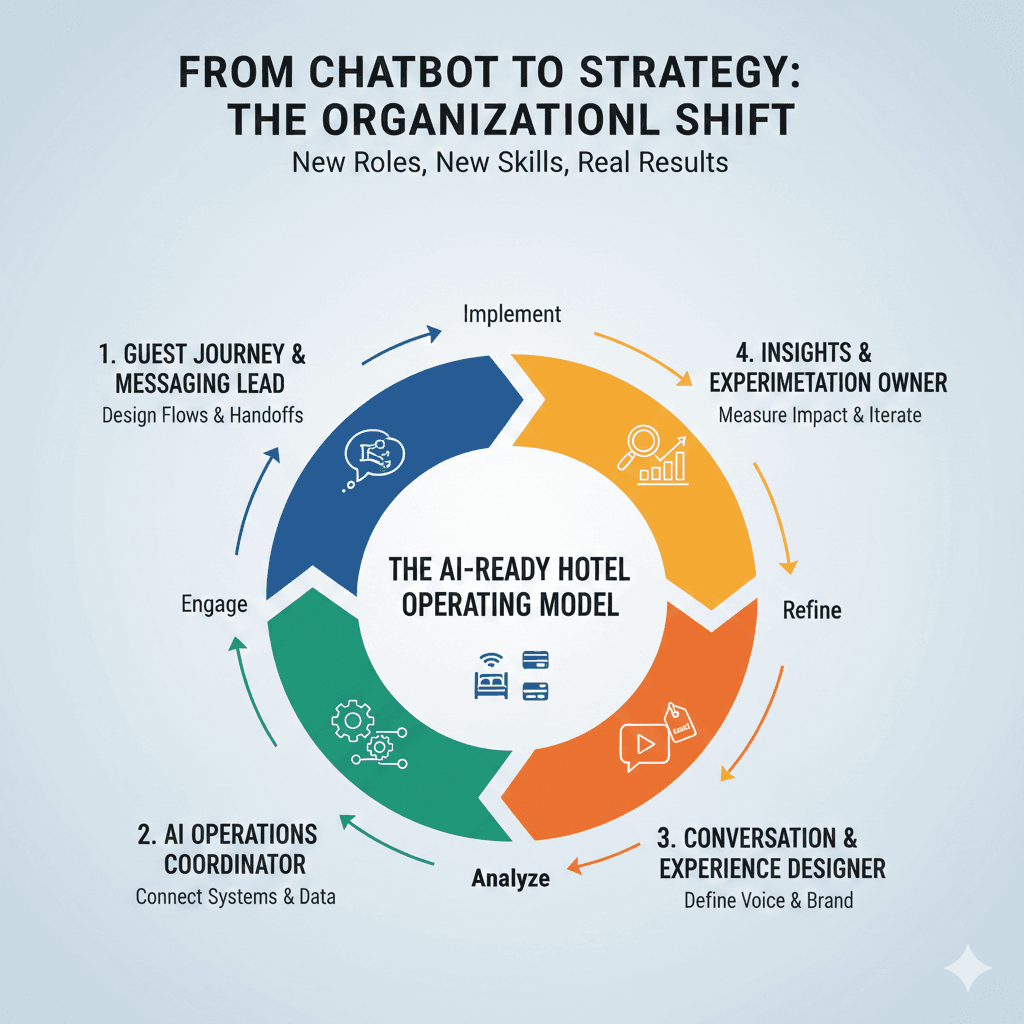
The AI-Ready Hotel Org Chart covers the roles that emerge. Beyond Check-In covers how the shape differs between a resort, a city hotel and a boutique. Only a tenth of hospitality leaders feel ready for AI covers what the rest should do first, and none of it is a technology decision.
Guest-facing content is increasingly read by machines before it is read by people — assistants answering "does this hotel have parking" without anyone visiting the site. That makes machine-readability an operational concern rather than a marketing one. The AI Protocol Shift is the argument for treating it that way now. The 69% who book from an AI summary is the demand side of the same shift, and Google AI Mode now books hotels is where it stops being a forecast.
If you are evaluating this for the first time: start with the messaging channel, because it is the one with a visible before-and-after and the shortest path to knowing whether it works. Measure the questions that stop reaching your desk. Then look at the predictive side, where the numbers are harder to move but easier to defend.
And ask every vendor what happens when their system does not know the answer.
A hotel AI is not set up once. It is taught, like a new employee who never leaves, and most of that teaching happens after launch, while the assistant is talking to guests.
It is the first question most hoteliers ask. The AI reads the website, it connects to the booking engine, it writes better than half the team. Why does it still take weeks of work…
Visitor centres, tours and activity parks look like hotels from the outside. Inside, the business is different.
Global platforms work in Israel until they meet the details: residency pricing, the Hebrew calendar, Hebrew tone, billing and local payment habits.
"Is there a pool?" has one fact behind it and many right answers. Your AI needs your tone and your house rules, not just your facts.
Every hotel that puts AI on its chat has to answer one question before anything else: when should the assistant stop selling and call a person?
The FAQ is the easy part of a hotel AI project, and it is also the part your guests could already find.
Should your hotel's AI assistant tell guests it is an AI? Two properties we work with answered in opposite ways, and both work.
A guest's WhatsApp message to a hotel that uses an AI assistant makes four stops: Meta, which delivers it; the vendor's servers, which store the conversation and look up the…
Google's AI Mode can now book a hotel room without the guest ever reaching the hotel's website. It started in the US, in English, with ten large chains and online travel agencies…
An AI concierge for hotels is an assistant that answers guests' messages on the hotel's behalf, usually on WhatsApp and web chat, from the hotel's own information and in the…

There is a moment in most implementations where an operator stalls. They have been shown a configuration screen, or a list of prompts, or a settings page, and they are trying to…

Attractions ask a different first question than hotels do.

A guest sends a voice note in Georgian. Nobody on your team speaks Georgian. It arrives at 9pm.

The question most operators ask early in an implementation is some version of what do you need from us? It is a good question, and the honest answer surprises people: very little…

An AI assistant is accurate on the day it launches. That is the last day anyone can take its accuracy for granted.

Bringing guest communication from every booking channel into one inbox is the easy part. Which of two kinds of platform you buy decides the rest.
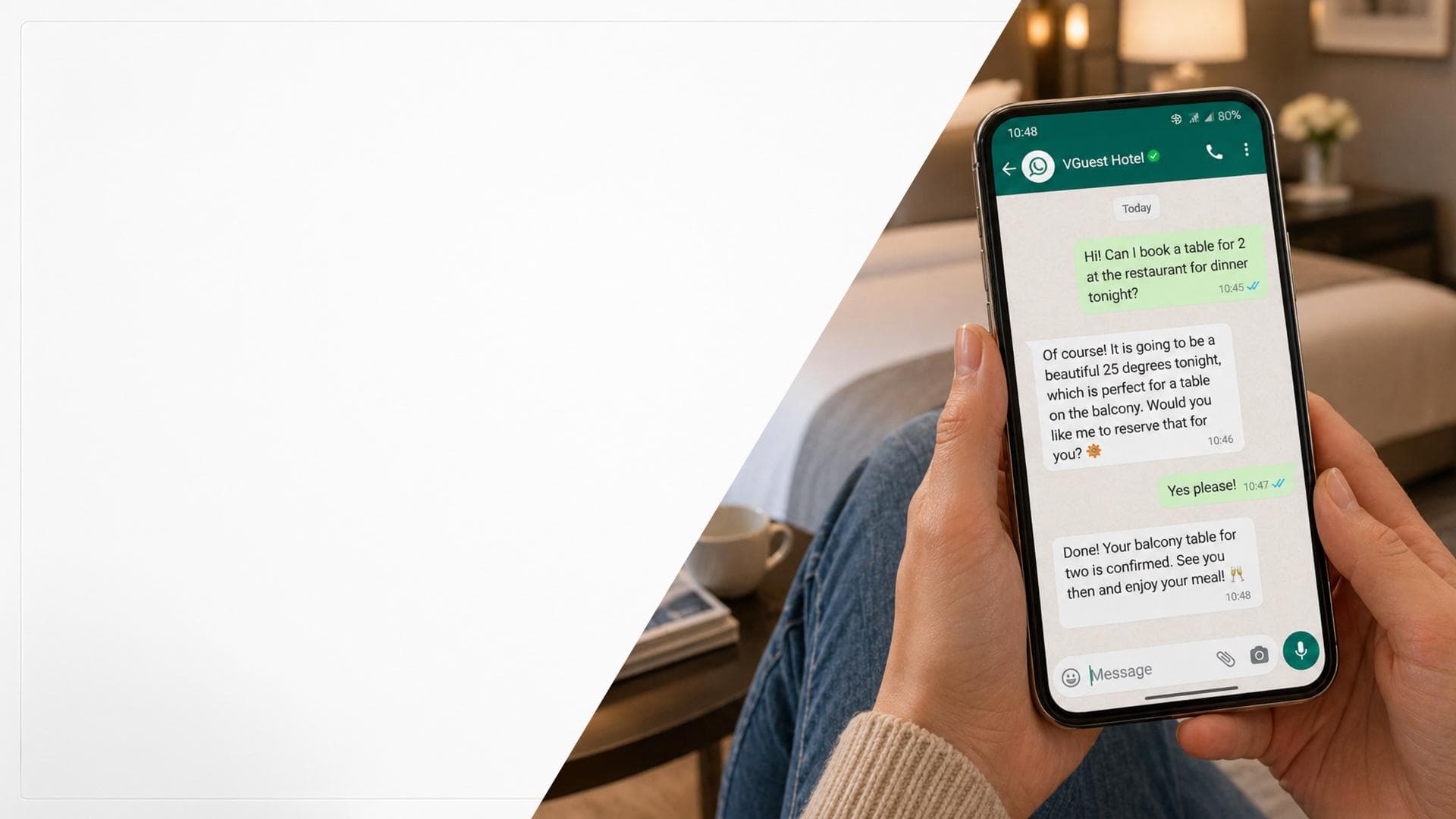
Every WhatsApp AI product for hotels demos well. The differences that matter are the ones you only discover in the second month, and none of them are on the feature comparison…

The phrase "hotel AI assistant" describes two products that share a demo and almost nothing else. Buying the wrong one is the most common expensive mistake in this category, and…

The word "AI" on a hotel technology invoice covers at least four different products, and the price does not tell you which one you bought. Knowing the difference is the single…

A hotel chatbot costs from $349 a month on our own price list, and from 1 October 2026 Meta charges for WhatsApp replies on top.

Guest messaging vendors are practised at demos. The way to get past the demo is a short list of questions that a good product answers in one sentence and a weak one cannot answer…

Two products are sold as "hotel chatbots", and the difference between them is the difference between the technology that failed in 2019 and the technology that works now. You can…

Guest messaging vendors use a vocabulary that sounds precise and is often not. These are the terms that come up in every evaluation, defined the way they are actually used in 2026…

You are on the phone with a frequent guest. She is halfway through asking for a late checkout when she says: actually, let me just have my assistant sort this out.

The message arrives on WhatsApp from a guest's number. It reads: Early check-in requested for the 14th, reservation under Weiss. Please confirm parking availability for a mid-size…

The survey figure doing the rounds in hospitality this year is that around one in ten industry leaders feels prepared for AI. Nine in ten do not.

Most hotel AI deployments that fail do not fail in the AI. They fail at the property management system - the assistant cannot see the reservation, cannot record what it did, or…

The most important configuration decision in a guest messaging deployment is not what the assistant answers. It is what it must never answer on its own. Most properties skip the…
Walk into most hotels that “use AI” today and you’ll see a familiar pattern.

You’re on the phone with a frequent guest. She’s halfway through asking for a late checkout and then says:

If you’ve sat through a technology pitch in the last 12 months, you’ve probably heard some mix of:

Today’s hospitality mandate is clear: deliver personalized experiences at operational scale. With staffing pressures mounting and guest expectations for digital fluency rising…

How modern hotels are redefining efficiency—from data-driven operations to intelligent automation—to maximize profitability and resilience.
The reservations team at a thermal spa and water park had a problem every reservations manager will recognise. Long phone queues, guests waiting minutes to be answered, and the…

Hospitality has always been emotional at its core. It’s about warmth, care, and the feeling of being seen. Yet, in an era dominated by dashboards and analytics, emotion often gets…

In hospitality, timing is everything. When a guest asks for something, it’s already a moment too late. The true magic happens when you anticipate what they need before they even…

You can predict which guests are most likely to cancel, spend, complain or come back — but only for behaviours your own systems already record, and only well enough to change who…

Automation has become a cornerstone of modern hotel operations. From self-check-in kiosks to automated guest messaging, systems now handle tasks that once required people. The…

In hospitality, communication isn’t a side task — it’s the heartbeat of the entire guest experience. Every message, every reply, every delay shapes how guests perceive care…
Three things reduce OTA dependence, and none of them is AI: rate discipline, so the direct price is never the worse deal; a booking path as easy as the OTA's; and a reply fast…
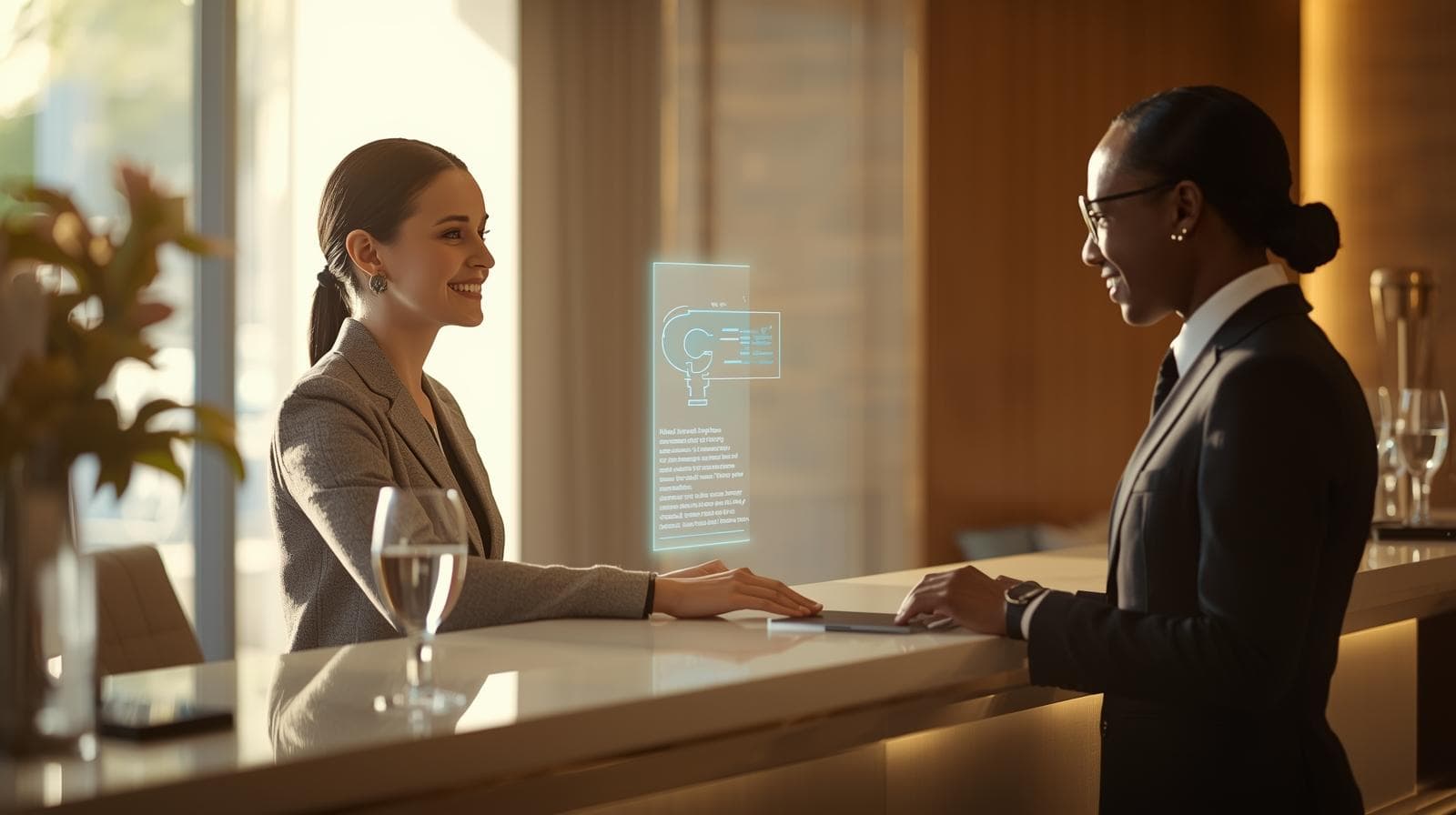
For years, hotels have tried to automate guest communication — from pre-arrival questions to mid-stay requests and post-stay follow-ups. But early chatbots were little more than…
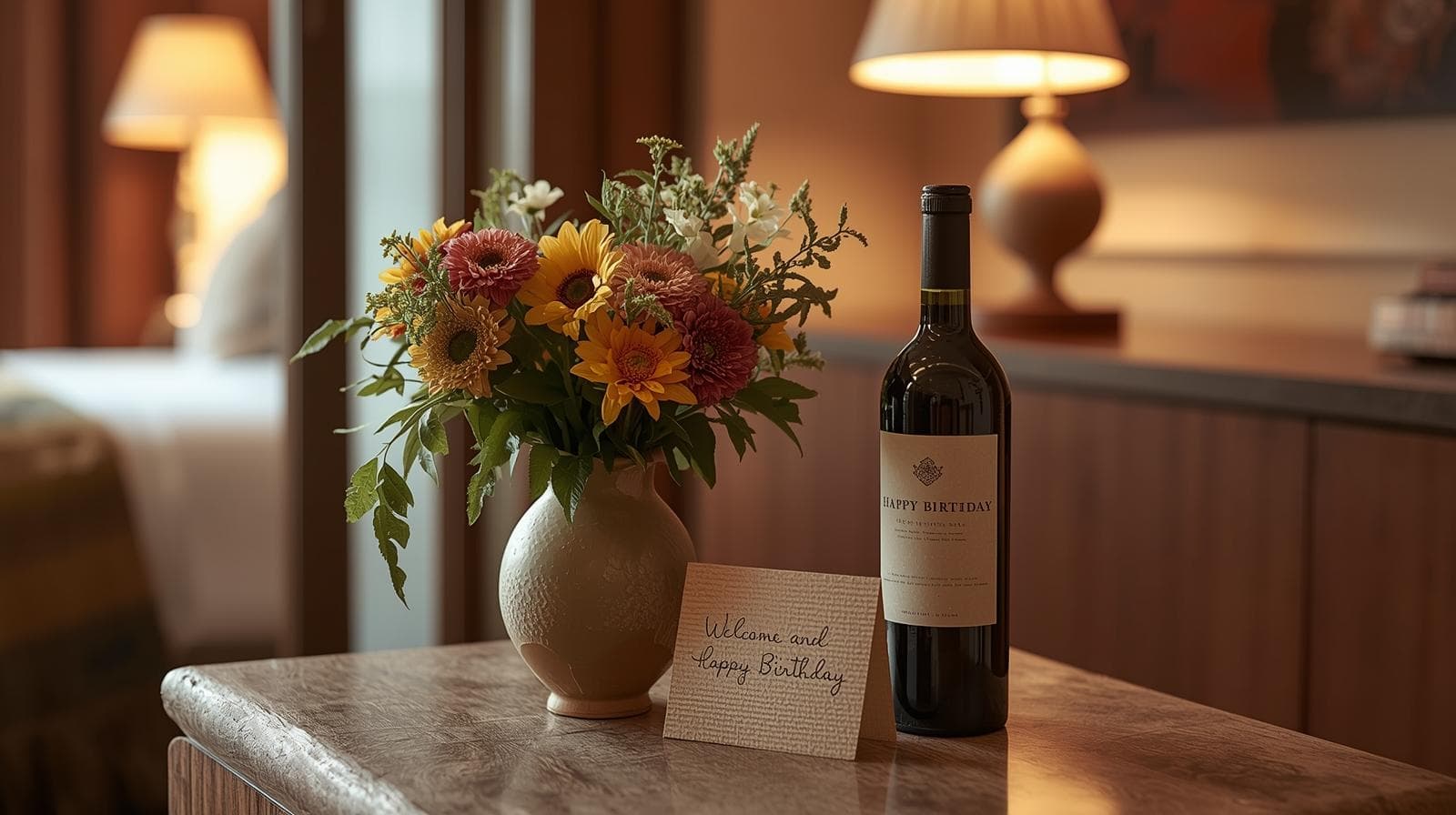
In hospitality, the art of selling has never been about pressure. It’s about perception — understanding the guest’s state of mind and meeting them there. When an offer arrives…
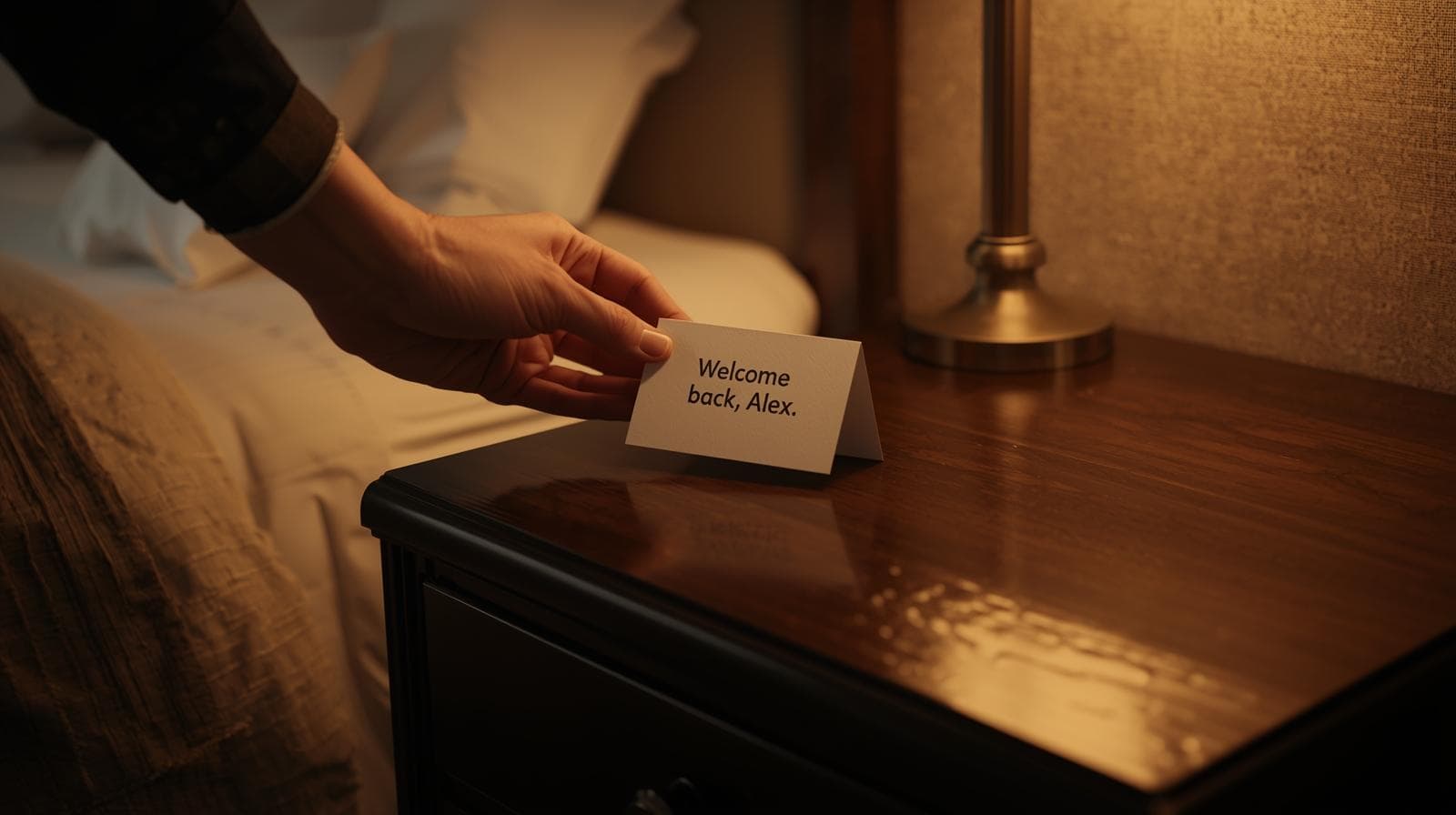
For decades, loyalty programs were built on math: points, nights, tiers, and redemption charts. Guests played the game because it made sense — stay more, earn more. But the rules…

Artificial intelligence is changing the rhythm of hotel operations. Guest messaging, pricing, housekeeping, even upselling — all are now guided by algorithms that promise speed…

In hospitality, service is constantly measured — but often for the wrong reasons.

Hospitality has always been about service — anticipating needs, noticing details, and delivering comfort before a guest even realizes what they want. But today, the way hotels…

A hotel chatbot is software that answers guest messages automatically, on the hotel's website or on messaging channels such as WhatsApp. The term now covers two different…

AI improves a hotel guest experience where speed and availability decide the moment: a question at two in the morning, in the guest's own language, answered before they have to…
Bring your own property. We will show you what the assistant does with your real questions, in your languages, on WhatsApp.
Running at 190+ properties in 6 countries