WhatsApp Business API for hotels: what it is, what it costs, how to get it
The WhatsApp Business API is how a hotel connects its WhatsApp number to software instead of a phone: a shared inbox, an AI assistant that answers guests, a link to the PMS. It is…
vGuest Team
vGuest
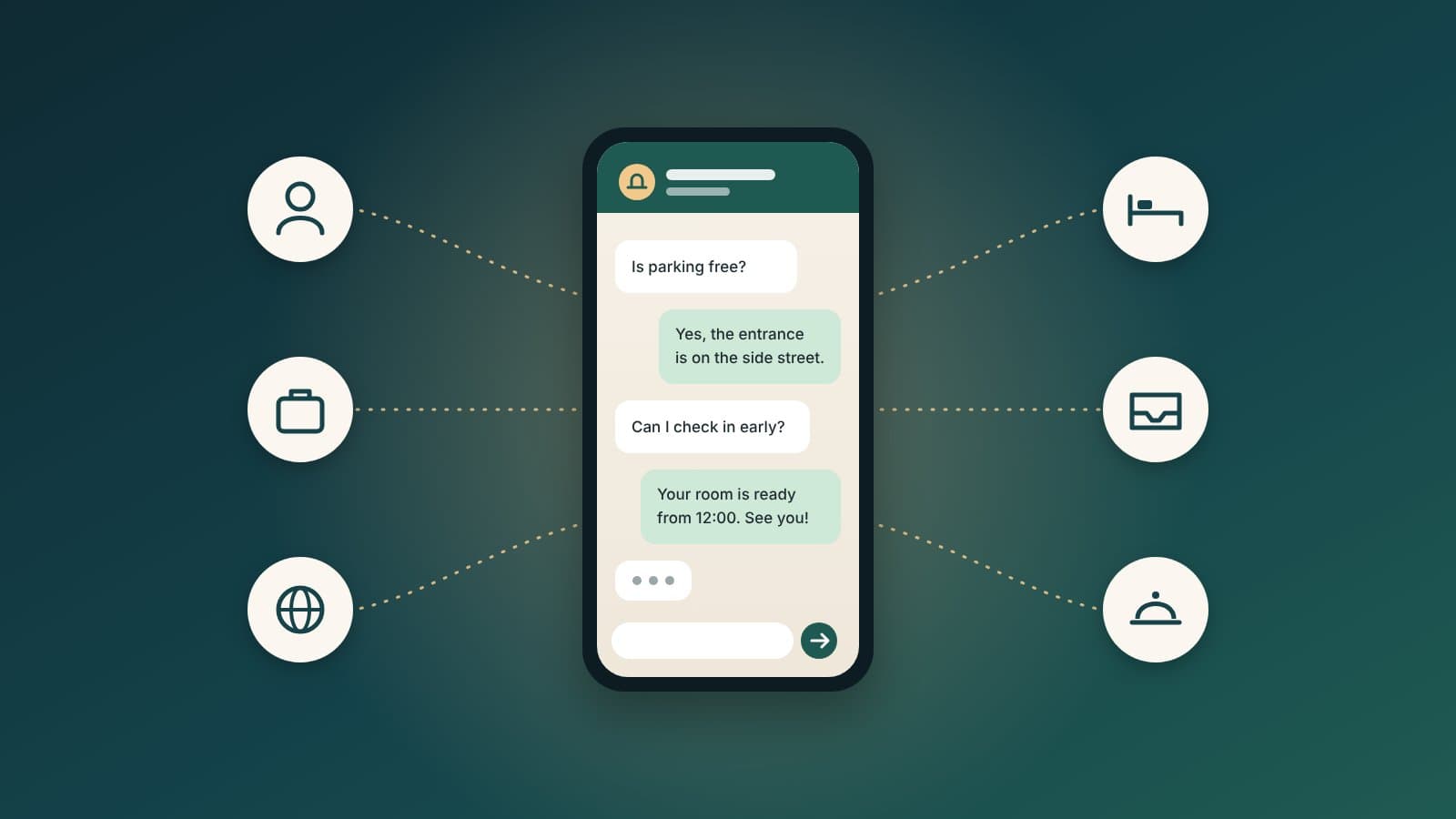
The WhatsApp Business API is how a hotel connects its WhatsApp number to software instead of a phone: a shared inbox, an AI assistant that answers guests, a link to the PMS. It is not free. Meta charges per delivered message, and since 1 October 2026 that includes the replies a hotel sends inside the 24-hour window. And there are three ways to get it, of which most hotels need only one.
This guide covers what the API is, the three routes to access, what it costs a hotel now, and the limits that decide what you can actually send. Across the 190+ properties vGuest runs, 97% of guest conversations arrive on WhatsApp (vGuest portfolio data, August 2026), so for most hotels this is not a side channel. It is the front desk.
What the WhatsApp Business API is, and what it is not
Meta calls it the WhatsApp Business Platform: "APIs for messaging and calling" for businesses (Meta, *WhatsApp Business Platform overview*, read 3 October 2026). When people say "the WhatsApp Business API" today, they mean the Cloud API, which Meta hosts.
There used to be a second option, the On-Premises API, which a business ran on its own servers. It is gone. Meta's final version expired on 23 October 2025, and messages sent to or from numbers still registered on it are not delivered (Meta, *On-Premises API sunset*, read 3 October 2026). If a vendor or an old proposal talks about hosting the API yourself, it is out of date.
The API is also not the WhatsApp Business app, the free app on a phone at reception. The app is one handset, one person, quick replies and away messages. The API is a number connected to software, several staff at once, approved templates and logs. The full comparison, including what you give up either way, is in WhatsApp Business app or the official platform for hotels.
Three ways a hotel gets access
1. Build on the Cloud API directly. Any business can. In practice it means a developer: access tokens, a webhook to receive guest messages, and software to read and answer them. It suits a hotel group with its own engineering team and a reason to own the integration. For a single property it is rarely worth it.
2. Connect through a guest messaging provider. The usual route. The provider is a Meta Tech Provider or Solution Partner, and Meta's Embedded Signup lets the hotel connect its number from the provider's own screens (Meta overview, read 3 October 2026). On vGuest this is Settings > Channels > Connect WhatsApp: log in with the Meta Business account, pick the number, confirm the code by SMS or voice call (vGuest docs, *Connect WhatsApp*).
3. Coexistence: keep the app, add the API. Meta lets a number run in the WhatsApp Business app and on the Cloud API at the same time. It is convenient, but it is a set of trade-offs, not the best of both: chat history syncs only with consent and only for 180 days, group chats do not sync, broadcast lists are disabled, and throughput is fixed at 20 messages per second, as covered in our app-or-platform guide. A coexistence number also cannot use the WhatsApp Groups API.
Whichever route you take, the number needs a Meta Business account, a phone line not already registered in the ordinary WhatsApp app, and working billing. Meta Business Verification is not required to start, but it is what lifts the sending limits below and it is a prerequisite for the blue tick.
What the WhatsApp Business API costs a hotel
Meta moved to per-message pricing on 1 July 2025, charged when a message is delivered, at a rate set by the guest's country calling code and the message category (Meta, *Pricing*, read 3 October 2026). A hotel in Munich replying to a guest with a UK number pays the UK rate.
The change hotels feel most took effect on 1 October 2026: "Meta will charge on a per-message basis for service messages, consistent with how Meta charges for template messages" (Meta, *Non-template message pricing*, read 3 October 2026). Service messages are the free-form replies inside the 24-hour window, which is most of what a hotel sends.
| Message | Hotel example | What it costs |
|---|---|---|
| Service (free-form reply) | "Yes, parking is free, the entrance is on the side street" | Charged since 1 October 2026, after 1,000 free per business phone number per month |
| Utility template | Booking confirmation, online check-in link | Charged |
| Marketing template | Spa offer, late check-out upsell | Charged |
| Anything within 72 hours of a Click to WhatsApp ad | Guest taps an ad and asks about availability | Free |
The 1,000-message free tier is per business phone number, resets monthly and does not roll over, as Meta's pricing page stated when we read it on 1 October 2026. A small property may stay inside it. A busy one will not, and a reply split across three message bubbles now counts as three. How to turn this into a budget line, by guest country, is worked through in WhatsApp replies to hotel guests stop being free in October, and the WhatsApp pricing calculator does the arithmetic.
Two things to ask any provider: whether Meta's charges are passed through at cost or bundled into the plan, and what happens when the free tier runs out mid-month. Without a payment method on file, Meta stops delivering service messages once the free tier is used, and the guest sees nothing. Hotel chatbot pricing covers the rest of a vendor quote.
The rules that decide what a hotel can send
The 24-hour customer service window. When a guest writes, the hotel can reply freely for 24 hours. Outside that window, every message the hotel starts must be an approved template: the booking confirmation, the pre-arrival message, the check-out reminder. Meta's review of a template can take up to 24 hours, and first submissions are often rejected over wording, so have your core templates approved before go-live, not on the day.
Utility or marketing is Meta's call, not yours. A check-in reminder with a breakfast offer at the bottom is a marketing message under Meta's categorisation rules, billed at the marketing rate. Keep operational templates clean and send offers separately.
Messaging limits. Meta caps the number of unique guests a business can message outside a customer service window in a moving 24-hour period. New businesses start at 250; the tiers above are 2,000, 10,000, 100,000 and unlimited. The limit is set per business portfolio and shared by all its numbers, so a hotel group with five properties under one portfolio shares one limit. Verifying the business is one of the ways to reach 2,000, and above that the limit rises automatically when a business sends high-quality messages and uses at least half of its current limit within seven days (Meta, *Messaging limits*, read 3 October 2026). Replies inside an open window are not what this cap measures, so for a property that mostly answers guests, 250 is rarely the constraint. For one that sends a pre-arrival message to every arrival, it can be.
Groups are small. The Groups API allows eight participants including the hotel, needs the blue tick, and does not work on coexistence numbers. Good for a family across three rooms, not for a wedding. Details in WhatsApp group chats for hotel guests.
Where the messages go
For hotels in the UK, Germany, Austria and Switzerland, this is usually the first question from whoever owns data protection. Message content always passes through Meta for delivery, whichever provider you use. The Cloud API offers an optional local storage setting that keeps message content at rest in a selected region, though content can still be processed in Meta data centres elsewhere for up to 60 minutes in transit (Meta, *Local storage*, read 3 October 2026). Check Meta's list of supported regions before assuming yours is on it.
Your provider's storage is a separate answer. vGuest stores conversation records in the EU, in Frankfurt. The full path of a guest's message, stop by stop, is in Where does a hotel guest's WhatsApp message actually go?
Checklist: getting a hotel number live on the API
- A dedicated number, not the owner's mobile and not one you will still want in the ordinary WhatsApp app.
- Admin access to the Meta Business account, and a payment method in Billing Hub before the first real send.
- Meta Business Verification started early. It lifts the messaging limit and it is needed for the blue tick.
- Core templates approved in advance: booking confirmation, pre-arrival, missed call, general update.
- A decision on coexistence, made knowing what it does not carry over.
- An owner for the inbox on every shift, and a rule for when the assistant hands a guest to a person.
- A PMS connection if you want answers about the guest's own booking. vGuest connects to Mews, Cloudbeds, Guesty and SimpleBooking, among others; without a PMS, an assistant can answer questions about the hotel but not about the stay.
Takeaway
For a hotel, the WhatsApp Business API is not a developer project. It is a decision about who connects the number, who pays Meta's per-message charges, and who answers at 2am. Get the number, the billing and the templates right first; the software on top is the easier part.
If you are comparing providers, WhatsApp AI for hotels: what to compare before you buy lists the questions that separate them.
Common questions
What is the WhatsApp Business API?
It is the set of APIs Meta offers businesses on the WhatsApp Business Platform, and in practice it means the Cloud API, which Meta hosts. Instead of one phone running the WhatsApp Business app, a hotel's number is connected to software: a shared inbox, an AI assistant, a PMS integration or all three, with approved templates for messages the hotel starts.
Is the WhatsApp Business API free for hotels?
No. Meta has charged per delivered message since 1 July 2025, at a rate set by the guest's country and the message category. From 1 October 2026 that includes free-form replies inside the 24-hour customer service window, after a free tier of 1,000 delivered service messages per business phone number per month. Messages within 72 hours of a guest arriving from a Click to WhatsApp ad stay free.
How does a hotel get access to the WhatsApp Business API?
Three ways: build directly on Meta's Cloud API, which needs a developer for access tokens and webhooks; connect through a guest messaging provider, which uses Meta's Embedded Signup so the hotel connects its number from the provider's own screens; or keep the WhatsApp Business app on the phone and add the API to the same number through coexistence, with the limits that brings.
Can a hotel send WhatsApp messages to guests who have not written first?
Yes, but only with a template Meta has approved, such as a booking confirmation or a pre-arrival message. Free-form messages are allowed only inside the 24-hour customer service window that a guest's own message opens. Meta also caps how many unique guests a business can reach with messages outside that window in a rolling 24 hours, starting at 250.
Does the WhatsApp On-Premises API still work?
No. Meta's final On-Premises version expired on 23 October 2025, and messages to or from numbers still registered on it are not delivered. The Cloud API is the API a hotel connects to today.
Keep reading
All articles
190+ properties · 6 countries
See it answering your guests
Bring your own property. We will show you what the assistant does with your real questions, in your languages, on WhatsApp.